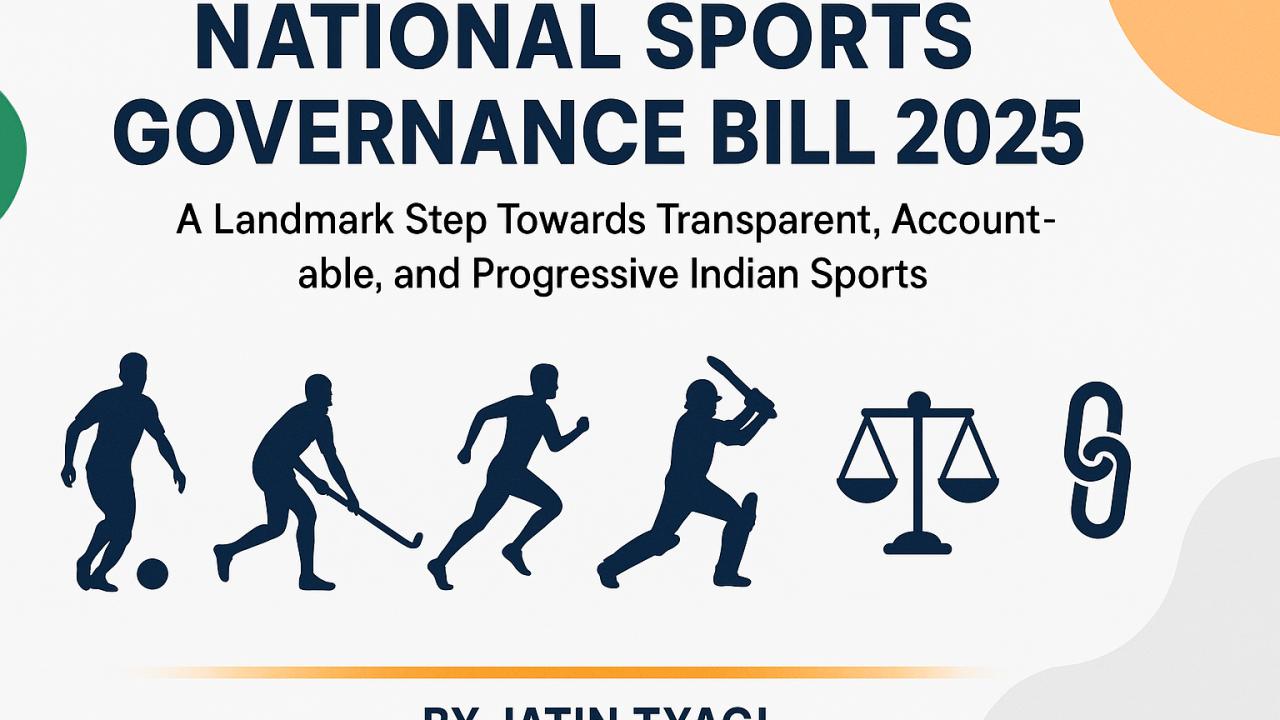
Analyst Report: National Sports Governance Bill and India's Olympic Dream 2036
By Dr. C. Ajithkumar
International Athletics Coach
Executive Summary
The National Sports Governance Bill 2025 represents a landmark reform in Indian sports policy. It signals a shift toward transparent governance, athlete-centric systems, and alignment with international standards. These elements are critical for sustainable performance enhancement and for India's aspiration to host and excel at the 2036 Olympic Games.
As an athletics coach with over 25 years of experience in developing world-class athletes, I view this legislation as both an opportunity and a strategic necessity for India's sporting ecosystem.
1. Purpose and Key Features of the Bill
The Bill seeks to standardize sports governance across federations and institutions, enhance accountability and transparency, and ensure fair representation. It institutionalizes athlete and coach involvement in decision-making, establishes formal grievance redressal mechanisms, and aligns Indian sports administration with international norms, particularly those of the Olympic Movement.
These measures are essential for building trust, reducing administrative bottlenecks, and creating an environment where performance and merit determine success.
2. Impact on Athlete Development and Coaching Systems
2.1 Athlete-Centric Governance
The Bill emphasizes athlete representation and welfare, ensuring that sports policies are shaped not only by administrators but also by athletes and coaches directly involved in competition. This shift can lead to improved selection and training structures, enhanced performance outcomes, and reduced conflict between federations and athletes or coaches.
From a coaching perspective, such frameworks help protect merit-based progression from administrative bias and uncertainty.
2.2 Coaching Empowerment
By formalizing grievance mechanisms and enforcing transparent administrative processes, the Bill provides coaches with greater clarity and security in long-term athlete development. This marks an important step toward professionalizing coaching and creating stable performance environments in Indian sport.
3. Effects on India's Olympic Vision 2036
3.1 Strengthened Bid Credibility
International Olympic evaluations assess governance integrity alongside infrastructure and financial readiness. The introduction of this Bill demonstrates India's commitment to global best practices and significantly strengthens its credibility as a potential host for the 2036 Olympic Games.
3.2 Performance Culture and Competitive Edge
Elite international success depends on structured systems supporting athlete preparation, injury prevention, psychological conditioning, and scientific performance monitoring. The Bill's focus on professional standards and athlete safeguards supports consistent elite performance, quicker dispute resolution, and long-term strategic planning.
Such systemic support is vital for India not only to participate at the Olympic level but to compete consistently for medals.
3.3 International Compliance and Anti-Doping
While India already maintains strong anti-doping legislation, improved governance alignment with Olympic standards enhances trust with international bodies. A robust compliance framework reduces the risk of sanctions that could affect participation or hosting ambitions.
4. Challenges and Strategic Considerations
The Bill's success will depend heavily on effective implementation. Strong legislation must be supported by trained administrators, adequate funding, and a culture that prioritizes merit over politics.
At the same time, while oversight is essential, sports federations must retain sufficient autonomy to innovate, manage sport-specific requirements, and respond to evolving international competition environments. Constructive collaboration between administrators and coaches will be key to maintaining this balance.
5. Conclusion and Recommendations
The National Sports Governance Bill represents a watershed moment for Indian sport. It establishes a long-awaited structural foundation capable of elevating both athletic performance and administrative excellence, thereby supporting India's Olympic ambitions through 2036 and beyond.
- Fast-track implementation through pilot programs in priority sports
- Invest in coach education and scientific training infrastructure
- Establish regular review mechanisms to assess and refine policy impact
- Strengthen grassroots-to-elite pathways to widen the national talent pool
6. Final Thought
With a clear vision, strong governance, and sustained investment in human capital, India can evolve from an emerging Olympic participant into a consistent global competitor and a credible host for the world's greatest sporting event.
Related Articles