
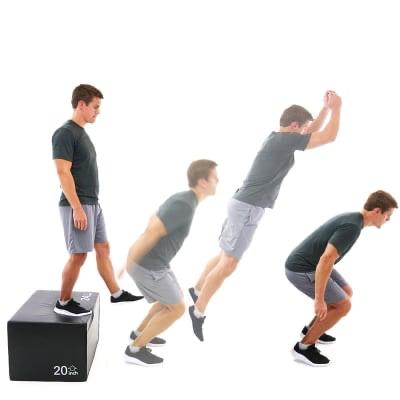
DROP JUMPS & RUNNING PERFORMANCE
Drop jumps can significantly improve running performance through biomechanical and ballistic adaptations.
Biomechanical Effects
Drop jumps are a plyometric exercise where the athlete steps off a box, lands, and immediately rebounds upward. This develops the Stretch-Shortening Cycle (SSC) -- the muscle's ability to store and release elastic energy rapidly.
- Eccentric control - Landing teaches muscles (especially quadriceps, hamstrings, calves) to absorb force efficiently.
- Shorter ground contact time - Training the fast amortization phase improves stride frequency.
- Reactive stiffness - Tendons (mainly Achilles) become stiffer and more elastic, increasing energy return.
- Force redirection efficiency - Enhances the ability to decelerate and reaccelerate vertically or horizontally, which is essential for sprinting.
- Neuromuscular coordination - Improves timing between agonist and antagonist muscles during landing and takeoff.
Result: The runner converts braking forces into forward propulsion with less energy loss, improving running economy and top-end speed.
Ballistic Effects
Ballistic refers to rapid, explosive movements using maximum acceleration through the entire range of motion.
- The landing-to-takeoff transition mimics ballistic muscle action -- short, powerful, and high-velocity.
- Develops Rate of Force Development (RFD), which is how quickly force is produced.
- Enhances motor unit recruitment, especially Type II fast-twitch fibers.
- Builds explosive rebound ability, vital for sprint strides and jump phases.
Result: The body learns to apply greater force in less time, directly enhancing sprinting, hurdling, and agility performance.
By Dr. C. Ajithkumar
International Athletics Coach
Related Articles