
Chapter 2
The Olympic Movement and India's Sporting Future
2.1 Introduction
"The Olympic Games are not merely a sporting event; they represent humanity's pursuit of excellence, peace, unity, and the limitless potential of human achievement."
In the twenty-first century, the Olympic Movement has evolved far beyond a global sporting competition. It has become a powerful platform for national development, youth empowerment, economic growth, technological innovation, international diplomacy, and social transformation. Every four years, the world's greatest athletes gather to compete not only for medals but also to represent the values, culture, and aspirations of their nations.
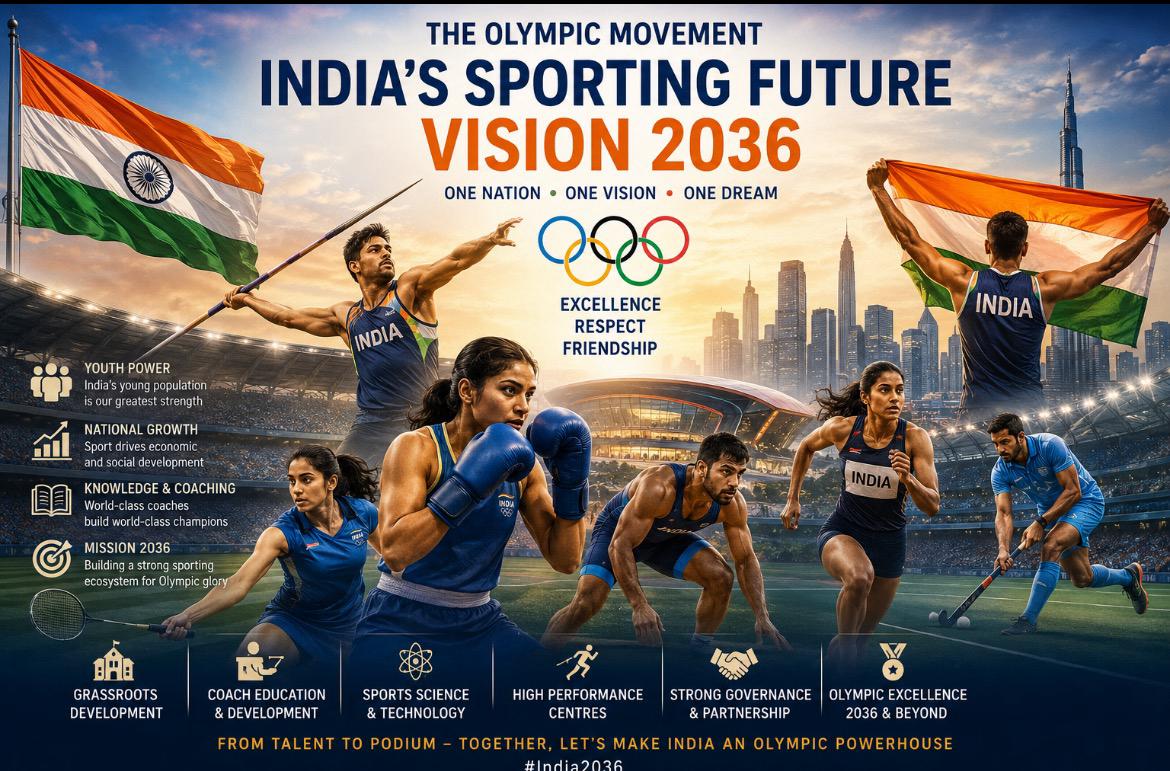
As India prepares for its ambitious vision of becoming a leading Olympic nation and aspires to host the 2036 Olympic Games, it is essential to understand that Olympic success is not achieved through talent alone. It is built upon a comprehensive national ecosystem that integrates education, scientific research, coaching excellence, sports governance, infrastructure, athlete welfare, and long-term strategic planning.
The Olympic Movement provides India with an extraordinary opportunity--not merely to organize a prestigious international event, but to transform the country's sporting culture and establish itself as a global leader in high-performance sport.
2.2 The Philosophy of the Olympic Movement
The Olympic Movement is founded on three fundamental values that continue to inspire athletes and nations across the world.
Excellence
Excellence means striving to become the best version of oneself. It is not solely about winning medals but about pursuing continuous improvement through dedication, discipline, perseverance, and lifelong learning.
Respect
Respect extends beyond competitors. It includes respect for coaches, officials, teammates, opponents, rules, diversity, ethics, and the spirit of fair play. Respect forms the moral foundation of sport.
Friendship
Sport has the unique ability to unite people across nations, cultures, religions, and languages. The Olympic Games demonstrate that peaceful competition can build mutual understanding and global friendship.
These values are not limited to sport. They contribute to building responsible citizens, stronger communities, and more inclusive societies.
2.3 India's Sporting Future
India possesses one of the greatest competitive advantages in the world--a young and dynamic population.
With more than 1.4 billion people, India has an enormous reservoir of athletic potential. Every village, town, school, college, and university contains young people capable of achieving international sporting excellence if provided with the right opportunities.
However, talent alone does not produce Olympic champions.
Champions emerge through:
- Early talent identification
- Scientific coaching
- Long-term athlete development
- Modern sports science
- High-performance competition
- Proper nutrition and recovery
- Psychological preparation
- International exposure
- Strong governance
- Continuous evaluation
India's future as a sporting nation depends upon building an integrated system that supports athletes from grassroots participation to Olympic podium success.
2.4 Sport as an Instrument of National Development
Around the world, sport has become an important driver of national progress.
Countries that consistently succeed in international sport also benefit from:
- Improved public health
- Youth development
- Employment generation
- Growth of the sports industry
- Tourism and event hosting
- Innovation and research
- International recognition
- National unity and pride
Sport is therefore not an expense.
It is an investment in human capital and national development.
A nation that invests in sport invests in healthier citizens, stronger communities, and a more productive economy.
2.5 The Historic Opportunity of 2036
The year 2036 represents a defining moment in India's sporting history.
India's ambition should extend beyond hosting the Olympic Games. The real objective should be to build a sustainable high-performance sporting system that continues to produce Olympic champions for generations.
To achieve this vision, India must:
- Develop world-class coaching systems.
- Strengthen grassroots talent identification.
- Integrate sports science into every training centre.
- Build high-performance centres across the country.
- Promote research and innovation.
- Encourage collaboration between universities and sports organizations.
- Expand opportunities for women and para-athletes.
- Create a nationwide culture of physical literacy and sporting excellence.
2.6 Lessons from Successful Sporting Nations
Australia
Following disappointing results at the 1976 Olympic Games, Australia established the Australian Institute of Sport (AIS), revolutionizing coach education, sports science, and athlete development.
United Kingdom
After poor performances at the 1996 Olympic Games, the United Kingdom restructured its high-performance system, leading to remarkable Olympic success over the following decades.
China
China developed a comprehensive national sports system based on long-term planning, scientific training, talent identification, and substantial investment in coaching and research.
Japan
Japan combined technological innovation, coaching excellence, discipline, and research to become one of the world's leading sporting nations.
These examples demonstrate that sustained Olympic success is never accidental. It is the result of deliberate planning, scientific preparation, and continuous improvement.
2.7 What India Must Learn
India can draw several important lessons from these successful nations:
- Coaching education must become a national priority.
- Continuous professional development for coaches should be mandatory.
- Sports science must become an integral part of daily training.
- Athlete development should follow a long-term pathway.
- Research and innovation should guide policy decisions.
- Performance analysis and technology should support coaching.
- Governance must be transparent, accountable, and athlete-centred.
Most importantly, knowledge must be continuously updated to keep pace with the rapid evolution of international sport.
2.8 Sport and Viksit Bharat 2047
India's vision of Viksit Bharat 2047 extends beyond economic development. A developed nation must also be a healthy, active, innovative, and globally respected sporting nation.
By 2047, India should aspire to:
- Become one of the world's leading Olympic nations.
- Develop internationally respected coaches.
- Establish high-performance centres in every state.
- Integrate sports science across all major training programmes.
- Promote sports research and innovation.
- Ensure every child has access to quality physical education and sport.
Sport should become an essential component of India's national development strategy.
2.9 The Central Message of This Policy Book
This policy book is founded on one fundamental principle:
- India has talent.
- India is increasing its investment in infrastructure.
- India's sporting ambitions are growing.
However, sustainable Olympic success requires one additional element above all others:
Knowledge.
Knowledge creates better coaches.
Better coaches develop better athletes.
Better athletes produce world-class performances.
World-class performances build Olympic champions.
Conclusion
The Olympic Movement offers India an unprecedented opportunity to redefine its sporting future.
Hosting the Olympic Games should not be viewed as the final destination. Rather, it should serve as the catalyst for transforming India's entire sporting ecosystem.
If India invests in coaching excellence, embraces scientific innovation, strengthens sports governance, and creates a culture of lifelong learning, the nation can emerge as one of the world's leading sporting powers by 2036 and beyond.
"Strong nations are built by healthy citizens. Healthy citizens are inspired by sport. Great sport is built by knowledgeable coaches. Therefore, investing in coaches is investing in the future of India."