
PART II - WHERE INDIA STANDS TODAY Chapter 6 Why India Still Lags Behind Sporting Nations Understanding the Systemic Challenges and the Path to Olympic Excellence India does not lack talent. India lacks a complete, knowledge driven high performance system that consistently transforms talent into Olympic excellence. 6.1 Introduction India is home to one of the world's largest youth populations, a rich sporting heritage, and rapidly improving sports infrastructure. Over...
PART II - WHERE INDIA STANDS TODAY
Chapter 6
Why India Still Lags Behind Sporting Nations
Understanding the Systemic Challenges and the Path to Olympic Excellence
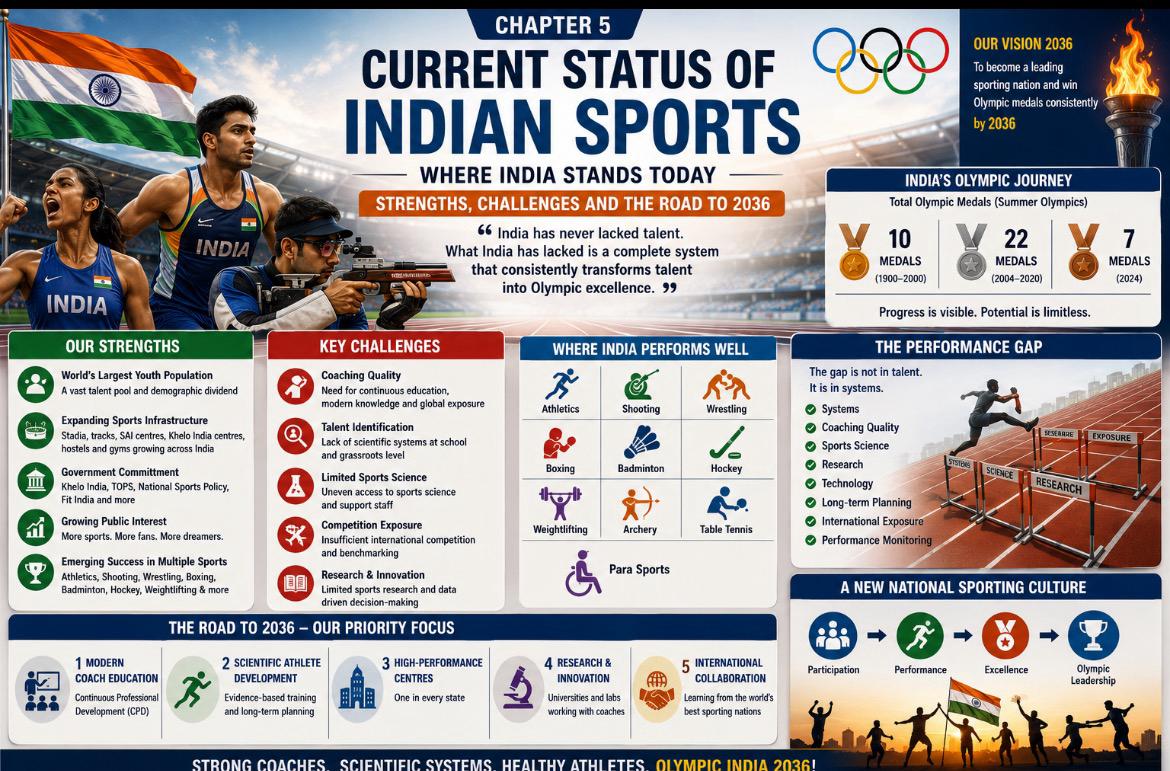
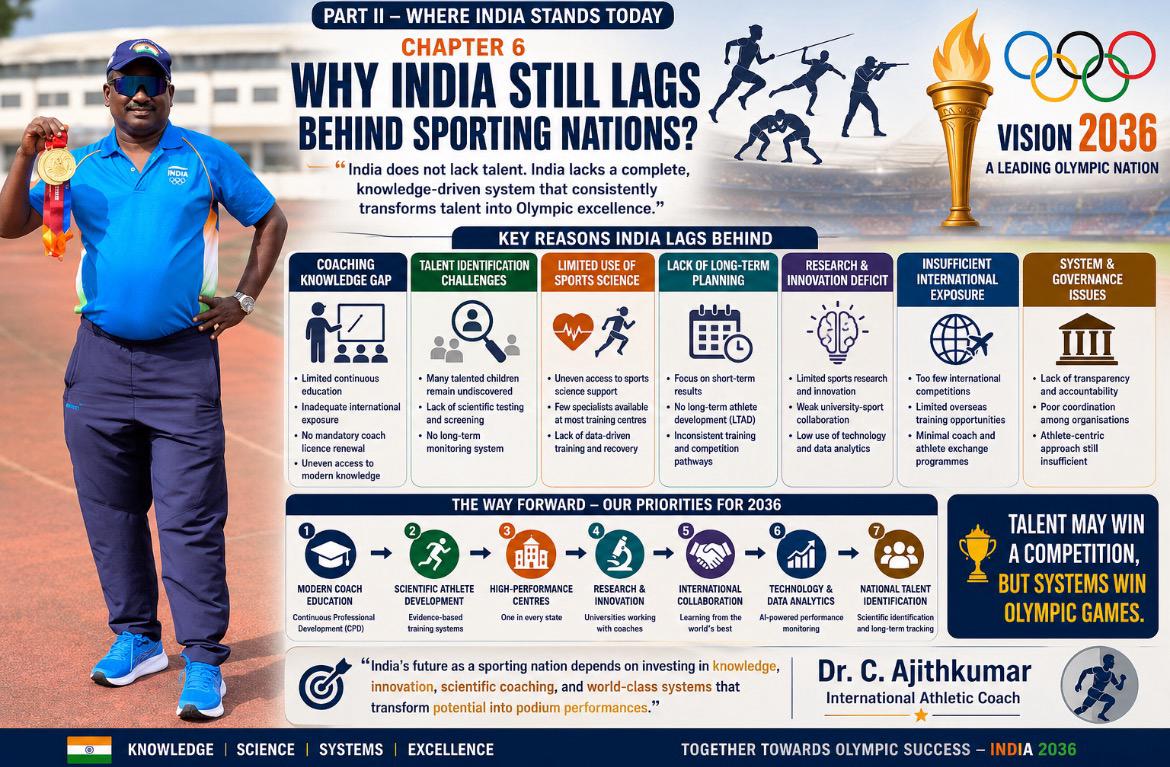
India does not lack talent. India lacks a complete, knowledge driven high performance system that consistently transforms talent into Olympic excellence.
6.1 Introduction
India is home to one of the world's largest youth populations, a rich sporting heritage, and rapidly improving sports infrastructure. Over the past two decades, Indian athletes have delivered remarkable performances at the Olympic Games, Paralympic Games, World Championships, Asian Games, and Commonwealth Games.
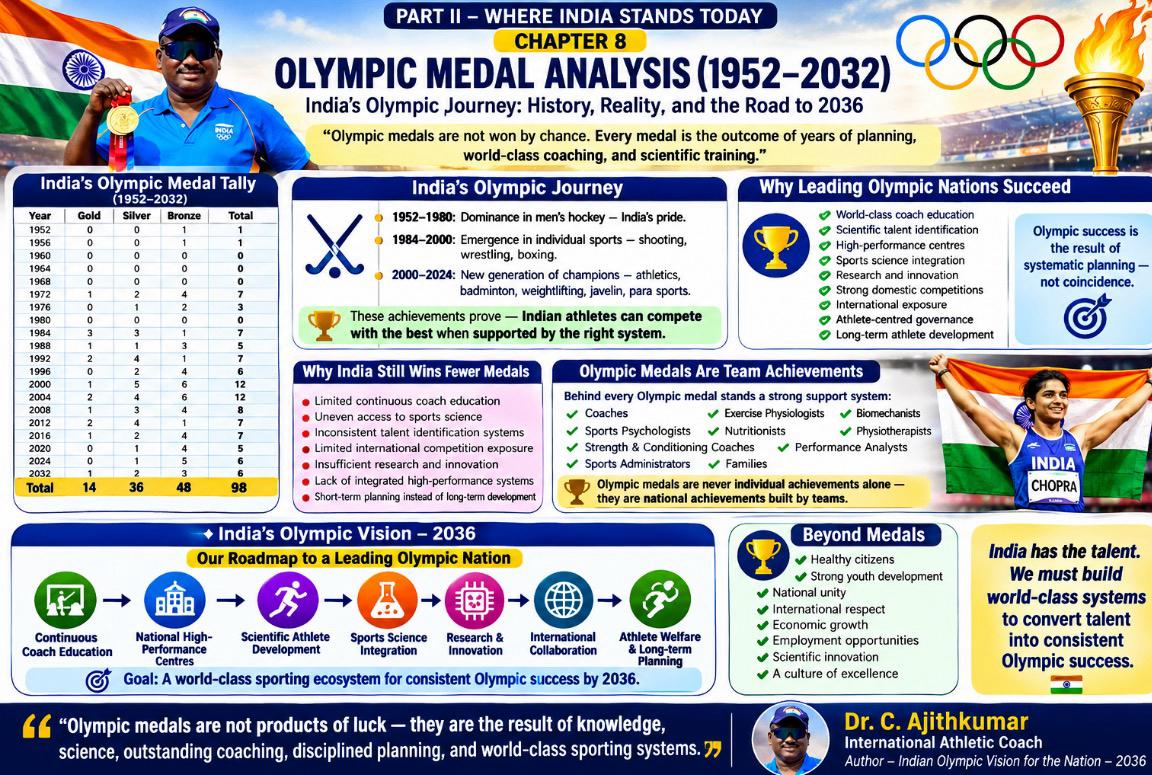
Despite this progress, India's overall Olympic medal tally remains far below that of leading sporting nations such as the United States, China, Japan, Australia, and the United Kingdom.
The question is not whether India has talent.
The real question is:
Why does a nation with such enormous potential still struggle to convert talent into consistent Olympic success?
To become a global sporting power by 2036, India must honestly examine the systemic challenges that continue to limit its performance.
6.2 The Problem Is Not Talent. It Is the System
India produces gifted athletes in every region of the country.
However, many talented children:
- Are never identified.
- Do not receive scientific coaching.
- Leave sport due to financial or social challenges.
- Lack access to quality facilities and competition.
- Never reach their true potential.
Talent alone does not create champions.
Systems create champions.
6.3 The Coaching Knowledge Gap
Coaches are the architects of athletic excellence.
India has thousands of dedicated and experienced coaches who have contributed significantly to sports development.
However, modern international sport demands continuous learning.
Current challenges include:
- Limited opportunities for continuous professional development.
- Inadequate international coaching exposure.
- Uneven access to sports science.
- Limited use of performance technology.
- Lack of mandatory coach licence renewal.
- Insufficient engagement with current research.
A nation's sporting success is directly linked to the quality of its coaches.
6.4 Limited Integration of Sports Science
In leading sporting nations, every training decision is supported by science.
In many parts of India, athletes still have limited access to:
- Exercise Physiologists
- Biomechanists
- Sports Psychologists
- Nutritionists
- Performance Analysts
- Recovery Specialists
- Strength and Conditioning Coaches
Scientific support should become a standard part of athlete development, not a privilege available only at elite centres.
6.5 Lack of Long Term Athlete Development
Developing an Olympic champion requires 8 to 12 years of structured preparation.
However, many programmes continue to focus on short term results rather than long term athlete development.
India must adopt:
- Long Term Athlete Development.
- Age appropriate training.
- Progressive competition pathways.
- Individualized performance planning.
- Sustainable athlete welfare programmes.
Olympic success cannot be built through short term planning.
6.6 Research and Innovation
Countries leading the Olympic medal table invest heavily in research.
Universities, sports institutes, and research centres work together to improve:
- Coaching science.
- Performance science.
- Biomechanics.
- Injury prevention.
- Sports technology.
- Artificial Intelligence.
- Data analytics.
India must strengthen the connection between universities and high performance sport.
6.7 International Exposure
World class athletes are developed by competing against the world's best.
India needs greater investment in:
- International competitions.
- Overseas training camps.
- Coach exchange programmes.
- Athlete exchange programmes.
- International collaborations.
- Exposure to global best practices.
Learning from successful sporting nations accelerates development.
6.8 Sports Governance and Leadership
Effective governance is fundamental to sporting success.
India should strengthen:
- Transparency.
- Accountability.
- Athlete centred decision making.
- Performance based evaluation.
- Long term strategic planning.
- Coordination among sports organisations.
Strong governance creates strong sporting systems.
6.9 The Way Forward
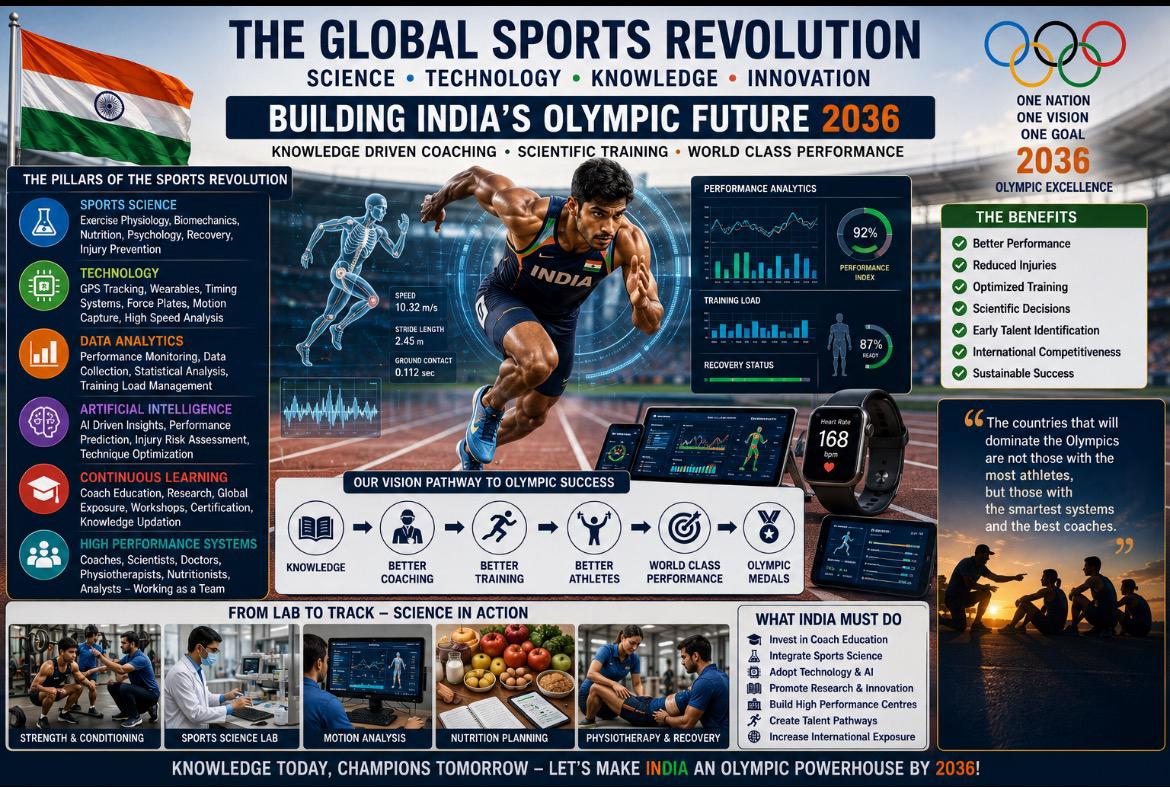
To become a leading Olympic nation by 2036, India should prioritise:
1. Modern Coach Education
Mandatory Continuing Professional Development for all coaches.
2. National Sports Science Network
Scientific support for athletes at every level.
3. High Performance Centres
One integrated High Performance Centre in every state.
4. Research and Innovation
Universities partnering with sports organisations.
5. International Collaboration
Learning from the world's leading sporting nations.
6. National Talent Identification System
Scientific identification and long term monitoring of young athletes.
7. Technology and Artificial Intelligence
Data driven performance monitoring and evidence based decision making.
6.10 Conclusion
India possesses everything required to become one of the world's leading sporting nations:
- Exceptional talent.
- A young population.
- Growing infrastructure.
- Government support.
- Increasing public interest.
The next stage of India's sporting journey must focus on:
- Coaching excellence.
- Sports science.
- Research.
- Innovation.
- International exposure.
- High performance systems.
- Continuous knowledge updation.
Only then can India consistently convert its enormous sporting potential into Olympic medals.
India's greatest resource is not its population. It is the untapped potential of its youth. Unlocking that potential requires knowledgeable coaches, scientific systems, and a national commitment to excellence.
Key Policy Recommendation
India should launch a National Sports Transformation Mission 2036, integrating coach education, sports science, research, technology, athlete welfare, governance, and long term athlete development into a single coordinated national high performance framework.
Talent may inspire hope, but only world class systems create Olympic champions. India's future as a sporting nation depends on investing in knowledge, innovation, and coaching excellence.
Dr C Ajithkumar
International Athletic Coach
Author, Indian Olympic Vision for the Nation 2036