
Chapter 4
The Global Sports Revolution
How Science, Technology, and Knowledge Have Transformed World Sport
Global Sports Revolution. How Science, Technology, and Knowledge Have Transformed World Sport.
The future of sport belongs not only to the strongest athlete, but to the nation that learns, innovates, and adapts the fastest.
4.1 Introduction
The world of sport has undergone an unprecedented transformation over the last five decades. What was once based primarily on experience, intuition, and hard work has evolved into a highly scientific, technology driven, and data oriented profession.
Today, Olympic champions are developed through the integration of sports science, biomechanics, physiology, nutrition, psychology, artificial intelligence, performance analytics, and continuous coach education.
Countries that have embraced this revolution have consistently dominated international sport.
For India, preparing for the 2036 Olympic Games requires embracing this Global Sports Revolution. Modern infrastructure alone is not enough. The true competitive advantage lies in knowledge, innovation, and scientific coaching.
4.2 Evolution of Sport From 1970 to 2036
The methods used to train athletes have changed dramatically.
| 1970 to 1980 | 2036 Vision |
|---|---|
| Stopwatch timing | Fully Automatic Timing and GPS |
| Coach observation | High speed video analysis |
| General training programmes | Individualized performance plans |
| Experience based decisions | Evidence based coaching |
| Manual record keeping | AI powered athlete management |
| Limited sports medicine | Integrated sports science teams |
| Basic strength training | Velocity based strength training |
| Traditional recovery | Scientific recovery protocols |
The evolution of sport demands an equally significant evolution in coaching knowledge.
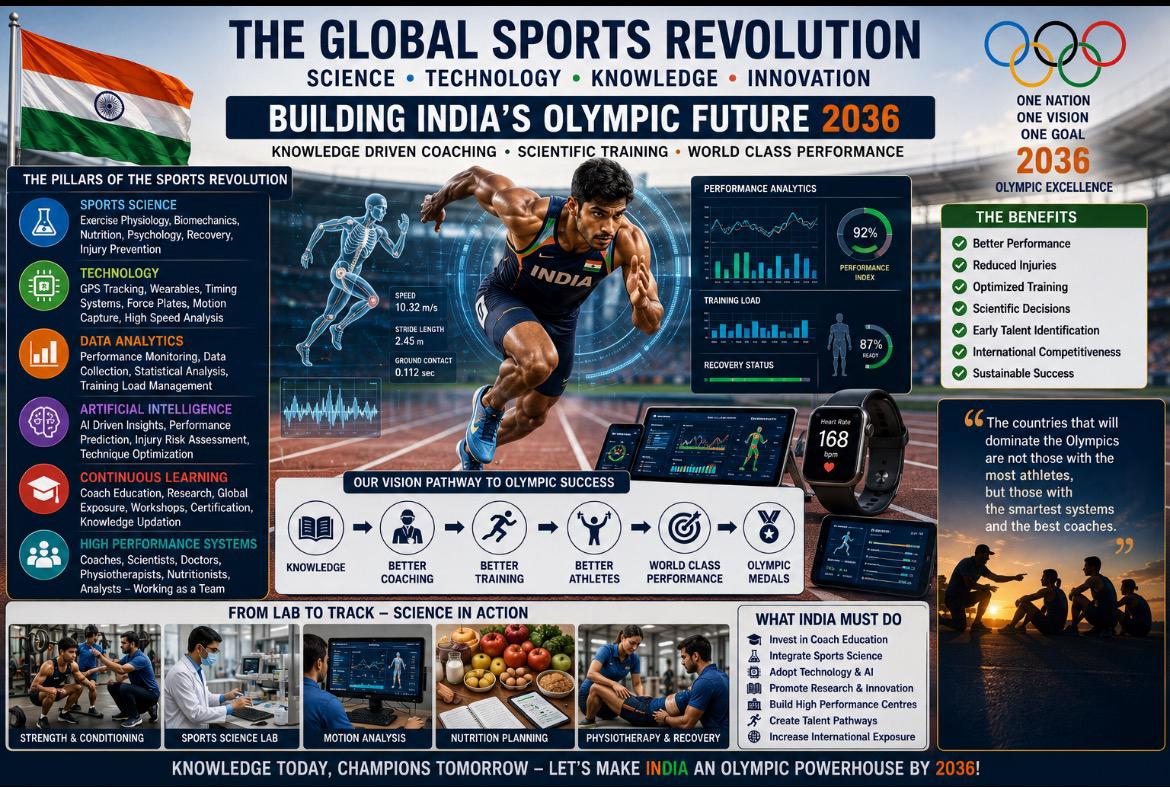
4.3 The Driving Forces of the Global Sports Revolution
1. Sports Science
Every training decision should be supported by scientific evidence.
This includes:
- Exercise Physiology
- Biomechanics
- Motor Learning
- Sports Nutrition
- Recovery Science
- Injury Prevention
- Strength and Conditioning
Scientific training improves performance while reducing injury risk.
2. Technology
Technology has transformed coaching.
Examples include:
- GPS Athlete Tracking
- Force Plates
- Timing Gates
- Motion Capture Systems
- Wearable Sensors
- Heart Rate Monitoring
- Performance Management Software
Technology enables coaches to make objective rather than subjective decisions.
3. Data Analytics
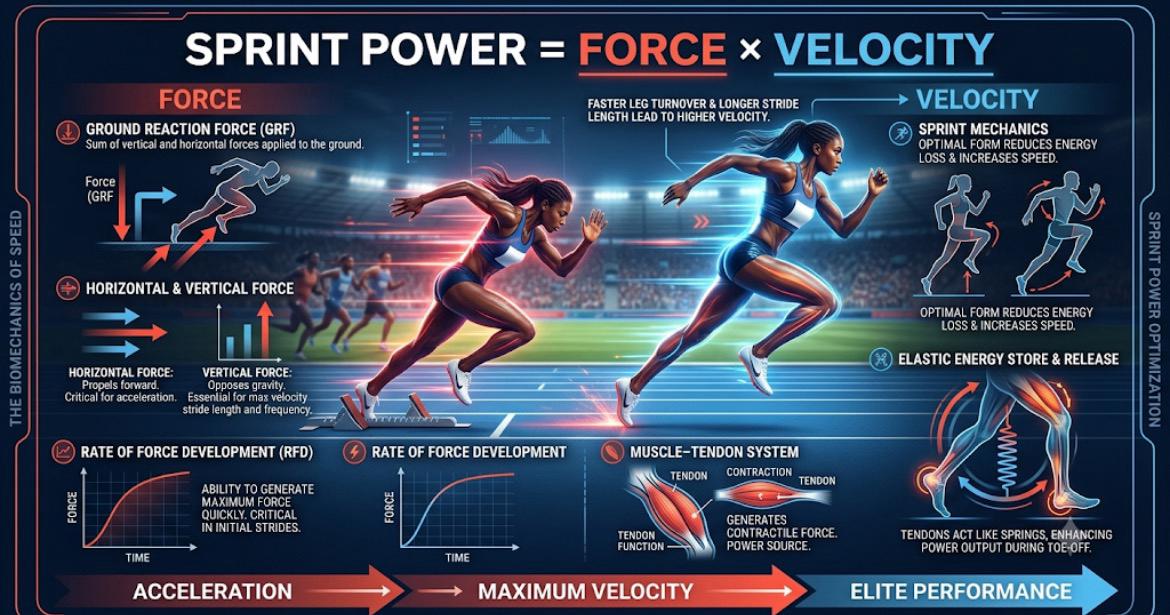
Elite sport is now data driven.
Every aspect of performance can be measured.
- Sprint speed
- Reaction time
- Ground contact time
- Jump height
- Power output
- Training load
- Fatigue levels
- Recovery status
Data helps optimize training and prevent overtraining.
4. Artificial Intelligence
Artificial Intelligence is rapidly changing elite sport.
AI can assist in:
- Performance prediction
- Injury risk assessment
- Training optimization
- Tactical analysis
- Opponent scouting
- Technique correction
- Athlete monitoring
Countries investing in Artificial Intelligence today will have a competitive advantage tomorrow.
5. Continuous Coach Education
Knowledge is now the most valuable performance enhancer.
The world's leading coaches:
- Attend international conferences.
- Study research papers.
- Collaborate with scientists.
- Exchange ideas globally.
- Upgrade their knowledge every year.
Learning never stops.
6. High Performance Systems
Olympic success depends on integrated support teams.
- Coaches
- Sports Scientists
- Physiotherapists
- Strength Coaches
- Nutritionists
- Sports Psychologists
- Biomechanists
- Performance Analysts
- Doctors
Champions are produced by teams, not individuals alone.
4.4 Global Best Practices
Australia
- Australian Institute of Sport
- Research driven coaching
- Coach development programmes
United Kingdom
- UK Sport
- National talent pathway
- Performance funding
United States
- University research
- NCAA competition system
- Innovation in sports science
Japan
- Precision coaching
- Technology integration
- Long term athlete development
China
- Centralized planning
- Scientific monitoring
- Early talent identification
These countries continuously innovate rather than relying on past success.
4.5 India's Opportunity
India possesses enormous advantages.
- Largest youth population.
- Growing economy.
- Expanding sports infrastructure.
- Government commitment.
- Rising public interest in sport.
- Strong digital ecosystem.
However, to compete globally, India must also become a leader in:
- Coach education.
- Sports science.
- Research.
- Innovation.
- Artificial Intelligence.
- Athlete performance monitoring.
4.6 The Need for a National Sports Knowledge Revolution
Infrastructure has limits.
Budgets have limits.
Equipment has limits.
Knowledge has no limits.
India should launch a National Sports Knowledge Revolution based on five strategic pillars.
Pillar 1
Modern Coach Education
Pillar 2
Sports Science Integration
Pillar 3
Technology and Artificial Intelligence
Pillar 4
Research and Innovation
Pillar 5
International Collaboration
Together, these pillars can transform Indian sport.
4.7 Recommendations for India 2036
- Establish High Performance Centres in every state.
- Introduce mandatory Continuing Professional Development for coaches.
- Create a National Sports Science Network.
- Develop Artificial Intelligence enabled athlete monitoring systems.
- Strengthen university based sports research.
- Increase international coach exchange programmes.
- Promote evidence based coaching.
- Build a National Digital Coach Education Platform.
4.8 Conclusion
The Global Sports Revolution has fundamentally changed how champions are created.
Olympic success is no longer determined solely by talent or hard work.
It depends on:
- Knowledge
- Science
- Technology
- Innovation
- Research
- Coaching Excellence
India stands at a historic moment.
If the nation embraces scientific coaching, invests in knowledge, modernizes coach education, and integrates technology into every stage of athlete development, it can become one of the world's leading sporting nations by 2036.
The Olympic dream will not be achieved through infrastructure alone.
It will be achieved through knowledge driven coaching, scientific excellence, and a culture of continuous learning.
Key Policy Recommendation
The Government of India should establish a National Sports Knowledge and Innovation Mission 2036 to integrate sports science, artificial intelligence, research, coach education, and technology into every level of Indian sport.
The countries that will dominate the Olympics in the future will not necessarily be those with the largest populations, but those with the smartest systems, the best coaches, and the strongest commitment to continuous learning.